

Last Updated: June 2026
New to pickleball? Learning the rules is easier than you might think. This guide explains everything you need to know—from serving and scoring to the kitchen rule—so you can step onto the court with confidence.
Quick Summary
If you only have a minute, here are the basic pickleball rules:
Pickleball can be played as singles or doubles.
Games are usually played to 11 points, and you must win by 2 points.
Only the serving team can score.
Serves must be underhand and hit diagonally.
The ball must bounce once on each side after the serve (the two-bounce rule).
Players cannot volley while standing in the Non-Volley Zone (Kitchen).
The ball is out if it lands outside the court lines.
Now let’s break each rule down in detail.
What Is Pickleball?
Pickleball is a paddle sport that combines elements of tennis, badminton, and table tennis. It’s played on a smaller court with a perforated plastic ball and solid paddles, making it easy to learn and enjoyable for players of all ages.
Whether you’re playing casually or preparing for tournaments, understanding the official rules helps make the game more enjoyable and fair.
Pickleball Court Layout
Before learning the rules, it’s helpful to understand the court.
The court measures 20 feet wide and 44 feet long, the same size for both singles and doubles.
The court includes:
Baselines
Sidelines
Service Courts
Centerline
Non-Volley Zone (Kitchen)
Court Dimensions
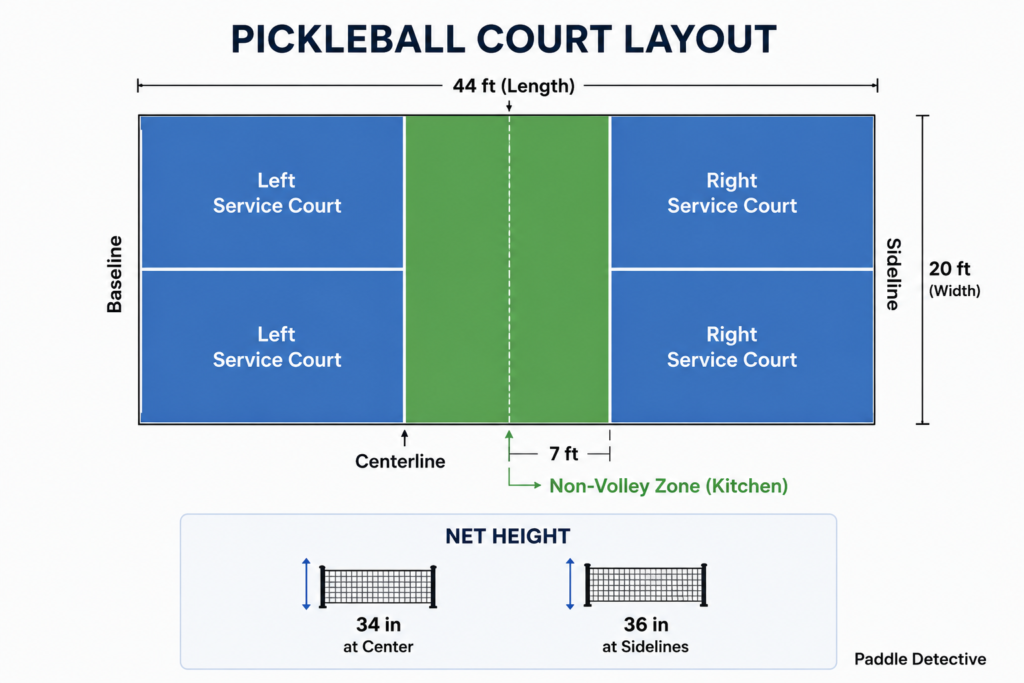
| Area | Measurement |
|---|---|
| Court Width | 20 ft |
| Court Length | 44 ft |
| Non-Volley Zone | 7 ft from the net |
| Net Height (Center) | 34 inches |
| Net Height (Sidelines) | 36 inches |
Equipment Needed
To play pickleball, you’ll need:
A pickleball paddle
A pickleball
A pickleball net
Comfortable court shoes
No special equipment is required beyond these basics, making pickleball one of the easiest sports to start.
How to Start a Pickleball Game
The game begins with a serve.
In doubles, each team gets two servers before the serve switches to the other team, except at the very beginning of the game when only one player serves first.
The serve always starts from the right-hand service court.
Pickleball Serving Rules
Serving is one of the most important parts of the game.
To make a legal serve:
Serve underhand.
Contact the ball below your waist.
The paddle head should remain below your wrist at contact.
Hit diagonally into the opponent’s service court.
Keep at least one foot behind the baseline until after striking the ball.
A legal serve must:
✅ Clear the kitchen.
✅ Land inside the correct service box.
✅ Not touch the net and land outside the service area.
The Two-Bounce Rule
One of pickleball’s unique rules is the two-bounce rule.
After the serve:
The receiving team must let the ball bounce once.
The serving team must also let the return bounce once.
Only after these two bounces can either team volley the ball.
This rule prevents the serving team from rushing the net immediately after serving.
What Is the Kitchen Rule?
The Kitchen, officially called the Non-Volley Zone (NVZ), is the seven-foot area on both sides of the net.
Players may enter the kitchen to play a ball that has bounced.
However, you cannot volley (hit the ball before it bounces) while standing in the kitchen.
You also cannot let your momentum carry you into the kitchen after hitting a volley.
Common Kitchen Faults
Volleying while standing in the kitchen.
Touching the kitchen line during a volley.
Falling into the kitchen after a volley.
Letting your paddle or body touch the kitchen while volleying.
How Scoring Works
Pickleball uses side-out scoring in traditional games.
Only the serving team can score points.
If the receiving team wins the rally, they gain the serve but do not earn a point.
Most recreational games are played to:
11 points
Win by 2 points
Tournament matches may also be played to 15 or 21 points.
Calling the Score
In doubles, three numbers are announced before every serve.
For example:
5–3–2
This means:
Serving team has 5 points.
Receiving team has 3 points.
Second server is serving.
In singles, only two numbers are called.
Example:
7–4
Singles vs Doubles Rules
The basic rules remain the same, but there are a few differences.
| Singles | Doubles |
|---|---|
| One server | Two servers per team |
| Covers the entire court alone | Court is shared with a partner |
| Faster movement | More teamwork and positioning |
Common Pickleball Faults
A fault ends the rally.
Some common faults include:
Hitting the ball out of bounds.
Serving into the kitchen.
Volleying from inside the kitchen.
Missing the ball.
Hitting the net.
Volleying before the two-bounce rule has been completed.
Double bouncing the ball on your side.
Can the Ball Hit the Net?
Yes.
If a serve clips the net but still lands in the correct service box, play continues.
The same applies during rallies.
Line Rules
In pickleball, all lines are considered in, except during the serve.
For serves:
The kitchen line is a fault.
Sidelines and baseline are in.
During rallies:
Any ball touching a boundary line is considered good.
Doubles Serving Rotation
Serving follows a specific order.
Each player continues serving until their team commits a fault.
After both teammates have served (except the first serving team at the start of the game), the serve moves to the opponents.
Understanding serving order becomes easier after a few games.
Beginner Tips for Learning the Rules
If you’re just starting, focus on these fundamentals:
Learn the kitchen rule first.
Remember the two-bounce rule.
Keep serves simple and consistent.
Don’t worry about advanced strategies initially.
Practice calling the score before every serve.
Most beginners become comfortable with the rules after only a few games.
7 Common Pickleball Rules Beginners Get Wrong
- Stepping into the kitchen after a volley
- Forgetting the two-bounce rule
- Calling the score incorrectly
- Serving above the waist
- Standing inside the baseline
- Serving into the kitchen
- Wrong serving position
These match real search intent.